

Empowering Families Through Accessible Health Resources

This project focused on addressing barriers to access in a public health initiative that provides nutrition and wellness support to underserved families. Through design thinking, research, and stakeholder interviews, we developed marketing strategies and engagement solutions to enhance accessibility, awareness, and outreach effectiveness. The goal was to create a more inclusive and user-friendly system, ensuring equitable support for families in need..
Client:
Deloitte
Duration:
10 Weeks
Role:
Project Manager | UX Researcher
Team:
10 designers
Overview
The SCADpro and Deloitte collaboration focuses on improving the accessibility and effectiveness of the Women, Infants, and Children (WIC) program, which provides essential nutrition support to eligible families. Despite its critical role in maternal and child health, only 51% of eligible families are currently enrolled due to barriers such as low awareness, difficulty accessing services, inflexible office hours, lack of online applications, privacy concerns, and cultural and language challenges.
This 10-week project aims to address these challenges through market research, the development of customer personas and journey maps, and the creation of a strategic marketing plan. By enhancing WIC’s outreach and service delivery, the project seeks to connect more families to this vital resource, reduce disparities, and improve maternal and child health outcomes.
We conducted independent research, worked closely with Deloitte to refine insights and strategies. The ultimate goal is to elevate Deloitte’s brand while designing user-centered solutions that make WIC more accessible and impactful for the communities it serves.
Project Brief
Our SCADpro collaboration with Deloitte focused on addressing barriers to access in a government assistance program that provides essential services to underserved communities. Despite its importance, the program faces challenges such as low awareness and accessibility, limiting participation.
Goal:
We aimed to create a marketing strategy that would increase awareness, improve accessibility, and help more individuals benefit from the program’s services.
Approach:
Using Design Thinking, we conducted user research and stakeholder interviews, developing prototypes and marketing solutions to address barriers and improve engagement.
Outcomes:
Our project aimed to enhance outreach and effectiveness, supporting better outcomes for underserved communities while giving us real-world experience in strategy and client collaboration.
Highlight & Process

Bridging the Gap: Expanding WIC Access through Strategic Outreach
Our research highlights a critical issue—while the Women, Infants, and Children (WIC) program serves approximately 6.7 million individuals, 51% of those eligible do not utilize its benefits. This gap stems from lack of awareness, logistical barriers, social stigma, and complex enrollment processes.
Primary Research
We conducted primary research through surveys, screeners, and community visits to understand the needs of parents with young children. By engaging diverse demographics in familiar settings, we gathered qualitative insights from 15 eligible participants, highlighting key challenges and opportunities within WIC.
Our research included 12 in-depth interviews, 50+ conversations, and over 1,100 data points, revealing key barriers in WIC. Insights highlighted issues with eligible products, convenience, outreach, application complexity, stigma, renewal challenges, and transportation. These findings guide program improvements to enhance engagement and support for families.

Locations
Farmers' market
Downtown Savannah
Grocery stores
CVS

Target Audience
Parents with young children

Key Insights from Our Research
Through extensive primary and secondary research, we identified several key barriers impacting WIC participation:

Strategic Approach
To address these challenges, we framed "How Might We" questions to guide our ideation process and used 2x2 prioritization mapping to refine our focus.

Ideation
After identifying the key barriers preventing WIC participation, we transitioned into the ideation phase to develop innovative solutions. This process involved multiple strategic steps to ensure our proposals were both impactful and feasible.

Lean UX Canvas
We employed a Lean UX Canvas to generate ideas and formulate our "We believe" statements, which guided our approach to improving the WIC program. The canvas consists of five key parts, the fifth being our solutions or concept proposal.
Business Problem
We identified critical challenges such as outreach, feelings of shame among participants, unclear eligibility questions, and issues related to convenience and transportation.
Business Outcome
Our goal is to increase WIC participation and simplify the application process, making it more accessible for families in need.
Users
Our primary users are eligible WIC participants and the program administrators who manage outreach and support.
User Outcome Benefit
We aim to achieve several benefits
for users, including increased voucher usage, greater engagement, heightened awareness of eligibility, and the building of a supportive community.


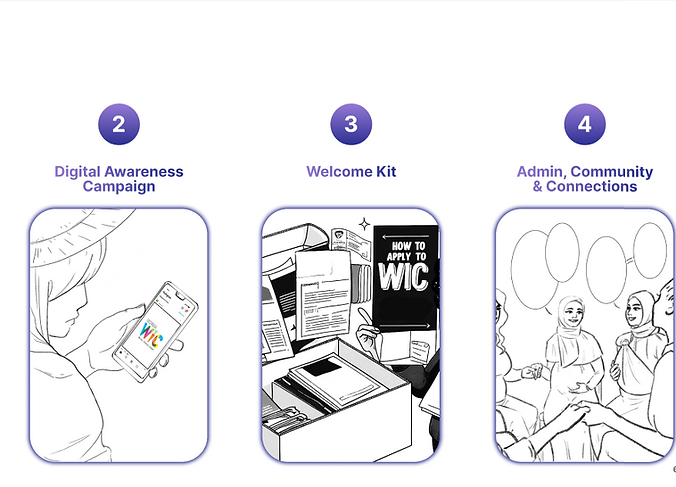
Converging on Four Final Proposals
Through multiple brainstorming sessions and stakeholder feedback, we consolidated our ideas into four key proposals that directly address the identified barriers:


My Contribution
From Ideas to Impact: Leading as Project Manager 🎯
"Good design is where strategy meets execution—and a little bit of magic."
Being the Project Lead meant juggling timelines, aligning diverse perspectives, and keeping the momentum going. With a Gantt chart in one hand and a RACI chart in the other, I steered a multidisciplinary team while ensuring seamless collaboration with Deloitte. It was all about problem-solving, clear communication, and strategic execution—turning challenges into opportunities and ideas into impact! 🚀
👥 Leadership & Team Management
Led a multidisciplinary team of students from diverse fields, including graphic design, service design, and marketing, ensuring smooth collaboration and project execution over the 10-week timeline.
📅 Project Planning & Execution
Developed and executed a comprehensive project plan, managing timelines, deliverables, and milestones to keep the team aligned and on track. Created a Gantt chart to visualize the project timeline and a RACI chart to define team roles and responsibilities, ensuring clarity in execution.
🎯Design Strategy
Integrated user-centered insights with business objectives, employing design strategy to create sustainable and impactful solutions for the initiative.
📝 UX Research & Testing
Conducted user interviews, surveys, and usability testing to identify pain points, validate solutions, and ensure an evidence-based approach to problem-solving.
🗺️ User Experience & Journey Mapping
Created user personas and journey maps, synthesizing research insights into actionable recommendations to enhance outreach and engagement strategies.
🤝 Client Collaboration & Communication
Served as the primary liaison with Deloitte, facilitating seamless communication, aligning objectives, and ensuring the project met client expectations.
Timeline
🚀 From Ideation to Impact: A Design Thinking Sprint
"Trust the process—because great solutions are built one iteration at a time."


Our 10-week journey followed the Design Thinking process, blending research, creativity, and iteration to tackle real-world challenges.
🔍 Empathize & Define (Weeks 1-3) – We dug deep into user insights, conducting interviews and research to understand key pain points.
💡 Ideate (Weeks 4-5) – With a solid foundation, we brainstormed solutions, mapped out approaches, and refined our concepts.
🛠️ Prototype & Test (Weeks 6-8) – We built, tested, and iterated our designs, ensuring they met user needs through rapid feedback loops.
🎯 Refine & Deliver (Weeks 9-10) – The final stretch focused on polishing our designs and preparing for the big presentation.
From Checkpoint 1 to the Final Presentation, every step was a collaborative sprint toward meaningful impact!
Retrospect
💡Reflections on Leadership and Learning
"Alone we can do so little; together we can do so much." – Helen Keller
Managing this project came with its challenges, particularly in recruiting participants for interviews. Since we needed individuals currently or previously enrolled in WIC, identifying and approaching them was difficult, even with a screener in place. Finding the right way to ask about their participation while ensuring comfort and trust was a learning experience.
Additionally, working under tight deadlines while keeping the team consistently motivated required strong coordination. As the project lead, balancing responsibilities and ensuring everyone stayed aligned was demanding but rewarding.
Despite these challenges, the project was an incredible experience. Our work was well-received by the Deloitte team, who appreciated our presentations and insights. Weekly stand-up calls with them provided valuable opportunities to address queries and challenges.
Most importantly, our diverse team—from different fields—came together to create something we were all proud of. The collaboration, learning, and impact of this project made it a truly fulfilling journey. 💪
